
SpaceTech Weekly Recap – April 6–12, 2026
Major funding, new missions and setbacks that mattered in space innovation last week.

Welcome to the newest edition of SpaceTech Weekly, your go-to source for space news. This recap is for informational purposes only and does not constitute investment advice.
“The space economy is growing well beyond rockets and launch pads. Seagate Space and Firefly are exploring offshore launch concepts, which could make getting to orbit more flexible and resilient. Atlas V just deployed a record number of Amazon satellites in a single mission, a clear sign that demand for large constellations is real and growing.
Investors are following the money into propulsion and satellite servicing. Portal Space is developing solar-thermal propulsion. Starfish Space is building Otter, a vehicle designed to service satellites already in orbit. Meanwhile, PLD Space is pulling in European funding and NASA’s Artemis II success is helping shape how public money flows into the broader ecosystem.“ - Commentary by Matej Pretković
I already wrote over 120 articles and weeklies on SpaceTech. That's a lot of reading. If you want the clearest path on what’s happening, I am building a course that covers everything you need to know without the rabbit holes. Join the waitlist.
We provide consulting for spacetech related topics. Contact us at mpretkovic@cyclopcorp.com
Here is a quick ovevriew of news that happened this week:
M&A & Funding
Portal Space Systems raises $50 million for spacecraft development
Starfish Space raises over $100 million
HawkEye 360 files for IPO
Spacety raises $190 million for satellite manufacturing and plans IPO
PLD Space gets $35 million loan from the European Investment Bank for MIURA 5 launcher
Market
White House asks for $18.8B budget for NASA in FY27
Launch
Atlas 5 launches Amazon Leo satellites
Artemis II returns to Earth with a successful splashdown
Contracts
Capella Space gets $49 million contract for military satellite demonstration
Seagate Space and Firefly Aerospace sign MOU for offshore launch infrastructure collaboration
Read our latest weeklies for more recent SpaceTech updates
Subscribe to keep up with the latest market movers in SpaceTech through carefully curated weekly updates
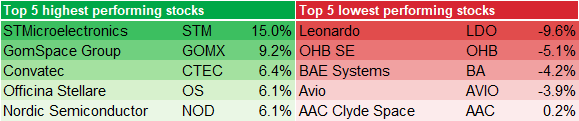
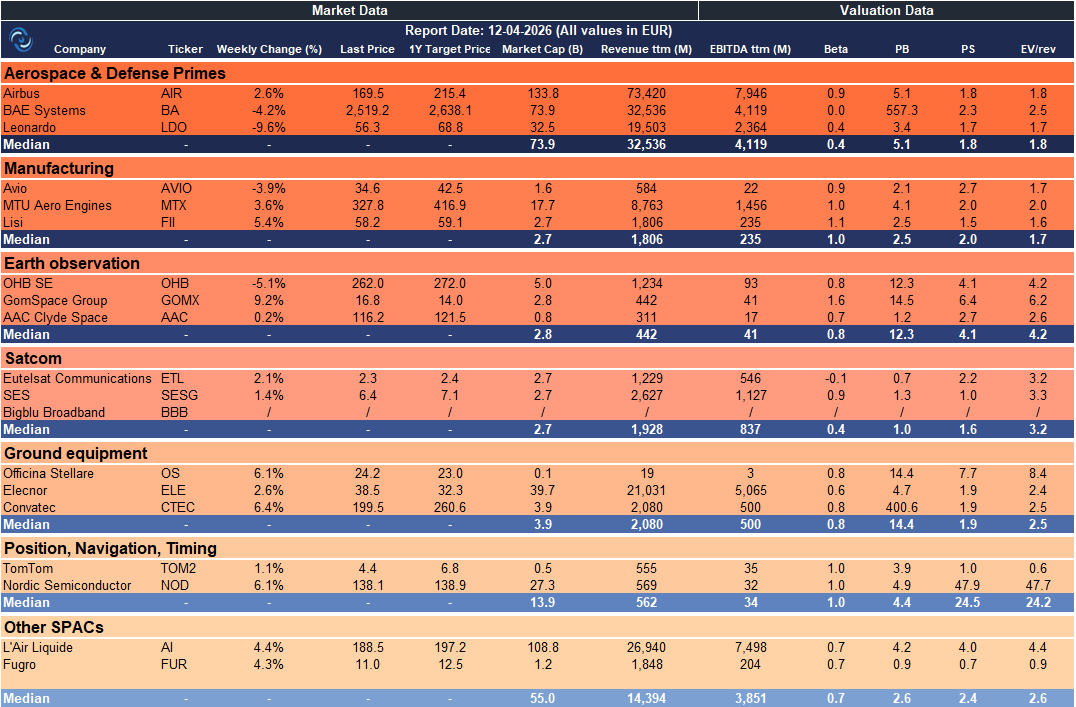
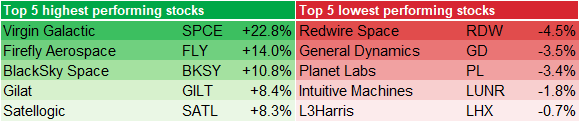
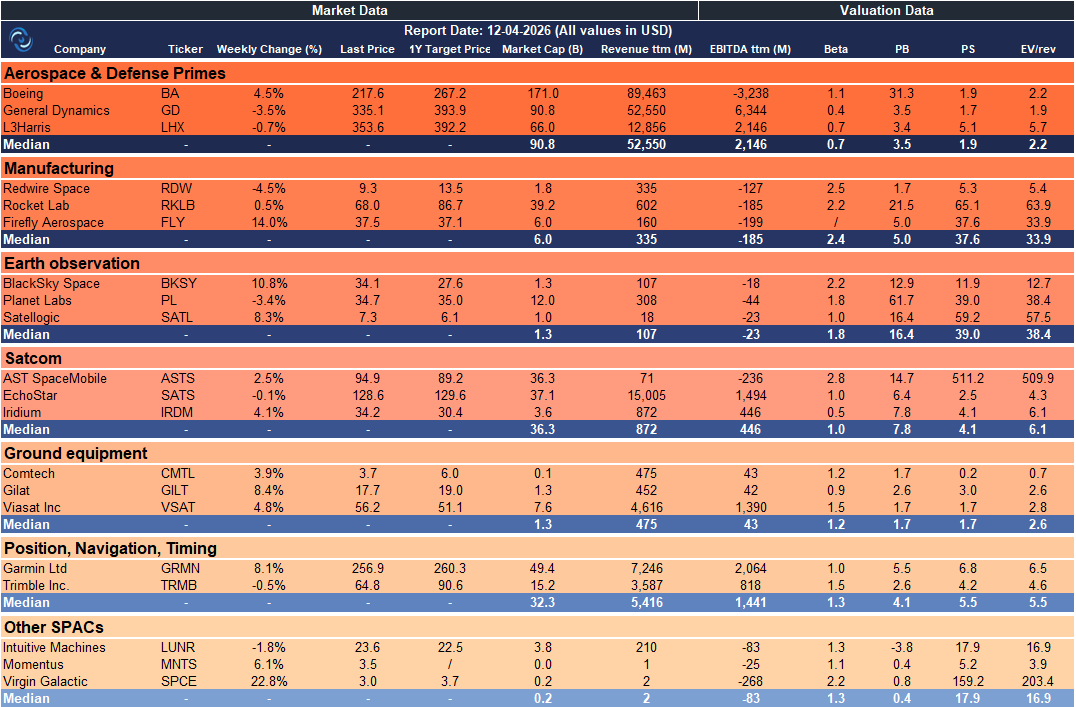
Weekly SpaceCap - These tables track weekly stock performance and key metrics for global and European SpaceTech companies, giving a quick snapshot of market trends. Data sourced from Yahoo Finance.
Europe – SpaceTech stocks snapshot
US – SpaceTech stocks snapshot
Read news in more detail
M&A & Funding
Portal Space Systems raises $50 million for spacecraft development
What happened: Portal Space Systems, founded in 2021, announced a $50 million Series A funding round valuing the company at $250 million. The round was led by Geodesic Capital and Mach33, with Booz Allen Ventures, ARK Invest, AlleyCorp, and FUSE participating. The company is developing solar thermal propulsion that uses concentrated sunlight to heat propellant for high-speed propulsion, aiming to bring the technology to orbit within about two years. Co-founders are Tim Thornburg, Ian Vorbach, and Prashaanth Ravindran; Thornburg previously helped develop SpaceX’s Raptor engine and has a background in the Air Force, Stratolaunch, and Amazon Project Kuiper.
Why it matters: Solar thermal propulsion could offer higher performance than chemical or solar-electric systems by using concentrated sunlight to heat propellant. The concept has been studied by NASA since the 1990s, with a 2003 report noting limited demand at the time; Portal aims to commercialize it for future spacecraft, signaling ongoing interest in advanced propulsion and potential new capabilities for orbital missions.
Investor angle: The funding round, led by Geodesic Capital and Mach33 with notable participants such as ARK Invest and Booz Allen Ventures, reflects investor confidence in Portal’s approach and its potential to commercialize a long-studied propulsion concept. Key considerations for investors include technology maturation timelines and the ability to achieve orbital deployment within two years.
Starfish Space raises over $100 million
What happened: Starfish Space announced a Series B of over $100 million led by Point72 Ventures, with Activate Capital and Shield Capital co-leading, and participation from existing investors NFX, Munich Re Ventures, Toyota Ventures, and PSL Ventures, plus new backers Nomi Capital, Gaingels, and Overlap Holdings. The funds will scale contracted Otter missions, as three demonstration missions have flown to date (Remora 2025 and Otter Pup 2 ongoing), with first full Otter missions planned for late 2026.
Why it matters: The round signals growing investor confidence in in-orbit servicing and autonomous space operations, an area already under contract with the U.S. Space Force, Space Development Agency, NASA, and SES. The funding and demonstrated traction point to accelerated development of a market for on-orbit servicing, life extension, and satellite disposal tasks.
Investor angle: The round validates Starfish’s Otter servicing platform and broadens its investor base with new entrants such as Nomi Capital, Gaingels, and Overlap Holdings. With these funds, Starfish aims to fulfill contracted missions and scale the business, potentially expanding its addressable market and strengthening readiness for future contracts and capital raises.
HawkEye 360 files for IPO
What happened: HawkEye 360, a U.S.-based signals intelligence and analytics company, has filed a registration statement (Form S-1) with the U.S. Securities and Exchange Commission (SEC) for a proposed initial public offering of its common stock. The company plans to list on the New York Stock Exchange under the ticker “HAWK,” though the number of shares and pricing range have not yet been determined. Major investment banks including Goldman Sachs, Morgan Stanley, RBC Capital Markets, Jefferies, and BofA Securities are serving as underwriters for the offering.
Why it matters: The filing signals that HawkEye 360 is entering the formal IPO pipeline, positioning itself to access public capital markets amid growing demand for space-based signals intelligence and RF data analytics. Its focus on detecting and geolocating radio-frequency emissions reflects increasing strategic interest in space-enabled defense, intelligence, and maritime domain awareness capabilities.
Investor angle: The S-1 filing highlights a potential public-market entry point into a niche space intelligence and AI analytics provider with strong defense and government exposure. The presence of top-tier underwriters suggests institutional confidence in market appetite. Key risks include regulatory approval timing, market volatility for defense-tech IPOs, and execution challenges in scaling satellite-based data infrastructure and analytics services.
Spacety raises $190 million for satellite manufacturing and plans IPO
What happened: Chinese satellite maker Spacety has completed multiple rounds of equity financing totaling $190 million to scale its vertically integrated satellite manufacturing and data services model, and it plans to pursue an initial public offering as it expands its manufacturing and data services platform globally.
Why it matters: Spacety’s funding underscores investor appetite for vertically integrated space manufacturing and data services, and signals growing momentum in Chinese commercial space efforts. The move comes as the company positions itself for an IPO, potentially capitalizing on increasing demand for satellite data and analytics.
Investor angle: From an investor perspective, the $190 million financing and IPO plans indicate a clear growth trajectory for Spacety’s integrated manufacturing and data services model, potentially boosting valuation ahead of a public listing. Risks include execution of scale-up and market timing, as well as competition in a rapidly evolving satellite market.
PLD Space gets $35 million loan from the European Investment Bank for MIURA 5 launcher
What happened: The European Investment Bank approved a loan of €30 million to Spain’s PLD Space to support the development and production of its MIURA 5 small satellite launcher. The headline lists the loan as $35 million, but the body states €30 million.
Why it matters: It matters because it signals continued European support for domestic space capabilities and for small-launch programs in a growing market for small satellites. By backing PLD Space’s MIURA 5, the EIB helps advance a European launcher option that could contribute to national and regional space ambitions.
Investor angle: From an investor perspective, the loan de-risks PLD Space’s MIURA 5 program by providing non-dilutive funding from a major public lender, potentially accelerating development and deployment timelines. It also signals EU backing for European launch capability, which could support future rounds or partnerships for the company.
Market
White House asks for $18.8B budget for NASA in FY27
What happened: The White House has requested a budget of $18.8 billion for NASA for fiscal year 2027. The request outlines the administration’s proposed funding for NASA programs, though final appropriations will depend on congressional action.
Why it matters: This funding level signals ongoing government support for space exploration, science missions, and technology development. It can influence planning for aerospace contractors, research institutions, and international collaborations, and may shape the pace and scale of U.S. space initiatives and private-sector opportunities.
Investor angle: The budget request signals potential contract opportunities for aerospace suppliers and technology firms, which could support revenue visibility and contract awards. However, outcomes depend on congressional approval and any changes to NASA programs, creating both opportunity and uncertainty.
Launch
Atlas 5 launches Amazon Leo satellites
What happened: The Atlas V rocket carried its heaviest payload to date, deploying 29 Amazon internet satellites into orbit. The mission marked Atlas V’s largest mass satellite deployment thus far and advances Amazon’s efforts to enable space-based internet capability.
Why it matters: The record payload demonstrates Atlas V’s capability to support large satellite constellations and underscores Amazon’s push to provide internet services from space. The development highlights a trend toward expanding broadband infrastructure via low Earth orbit deployments using commercial launch services.
Investor angle: For investors, the flight signals sustained demand for large, multi-satellite deployments and emphasizes the value of reliable, high-capacity launch options for big constellation programs. The milestone could influence expectations around orders and potential valuation implications for launch providers and Amazon’s satellite internet program.
Artemis II returns to Earth with a successful splashdown
What happened: Artemis II ended its 10-day mission with a Pacific splashdown off San Diego at 8:07:27 p.m. ET. The crew Reid Wiseman, Victor Glover, Christina Koch, and Jeremy Hansen were recovered from the Integrity capsule after re-entry at over 38,000 km/h. NASA called it a textbook entry and bullseye splashdown.
Why it matters: This mission marks a major milestone for NASA’s Artemis program, serving as a test for future crewed Moon missions and advancing lunar exploration capabilities. It delivered first Earth photos since Apollo 17, set a record for the farthest distance traveled by humans, and featured the first view of the Moon’s dark side.
Investor angle: The mission’s success could bolster confidence in ongoing NASA funding and related aerospace programs, supporting suppliers and contractors tied to Artemis milestones. The events demonstrate civil-space demand and potential for future government contracts, collaborations, and technological development in lunar exploration infrastructure.
Contracts
Capella Space gets $49 million contract for military satellite demonstration
What happened: Capella Space has secured a $49 million contract from the U.S. Space Development Agency (SDA) to develop and demonstrate two satellites for military communications in low Earth orbit. The project falls under SDA’s HALO (Hybrid Acquisition for Proliferated Low Earth Orbit) program and will test advanced capabilities such as adaptive beamforming, secure tactical waveforms, and resilient communications under interference conditions, with demonstrations expected by 2027.
Why it matters: The award reflects growing investment in space-based military communications and the broader push by the U.S. Space Force to build a resilient proliferated satellite architecture. It also highlights increasing reliance on commercial space companies to rapidly prototype and deliver defense capabilities, particularly in contested or jammed communication environments.
Investor angle: The contract reinforces Capella Space’s position in the defense-oriented space sector and its expansion beyond radar imaging into RF-enabled communications technologies. It signals continued demand for dual-use satellite infrastructure, though risks remain around program execution, defense procurement timelines, and competition among commercial space firms vying for SDA demonstration and production contracts.
Seagate Space and Firefly Aerospace sign MOU for offshore launch infrastructure collaboration
What happened: Seagate Space Corporation signed a Memorandum of Understanding with Firefly Aerospace to develop an offshore launch platform for sea-based launches of Firefly’s Alpha rocket. The collaboration centers on integrating Seagate’s Gateway Series, a modular, semi-submersible spaceport with DP station-keeping, following ABS Approval in Principle. MIT Sea Grant testing validated sea-launch capabilities on a model.
Why it matters: This collaboration advances offshore launch capabilities as a practical, mobile, and globally accessible option for orbital missions, complementing traditional land-based pads. It supports a range of missions, including hypersonic testing, missile defense, and commercial launches, and offers access to additional orbits and mission profiles beyond conventional launch constraints.
Investor angle: Investors may view this deal as expanding Seagate Space’s addressable market through offshore spaceports, leveraging Gateway’s DP-stability with Firefly’s Alpha vehicle to offer rapid-launch and resilient infrastructure. Risks include regulatory, technical, and schedule uncertainties, but ABS AIP and the accompanying testing milestones enhance credibility and execution prospects.
Disclaimer: This article is provided for informational purposes only and does not constitute investment advice. While we strive to ensure the accuracy and timeliness of the information presented, we cannot guarantee its completeness or correctness. Readers should conduct their own research and consult a qualified financial professional before making any investment decisions. Past performance is not indicative of future results.