
SpaceTech Weekly Recap – March 30 – April 5, 2026
Major funding, new missions and setbacks that mattered in space innovation last week.

Welcome to the newest edition of SpaceTech Weekly, your go-to source for space news. This recap is for informational purposes only and does not constitute investment advice.
“For the first time in 50 years, humans are heading back near the Moon, and the excitement is spreading fast.
Italy just aligned with NASA on Moon infrastructure, while Artemis II is testing how far public-private partnerships can stretch into deep space. China is scaling up launch activity fast.
On the commercial side, Virgin Galactic is reviving its tourism plans, Rocket Lab is pushing laser comms into Europe and Antaris is advancing software-defined satellites. AI-enabled multi-sensor platforms are quietly lining up for recurring government contracts.
A short week, but great for SpaceTech. Almost everything closed in the green.“ - Commentary by Matej Pretković
Interested in a SpaceTech Business Course?
Here is a quick ovevriew of news that happened this week:
M&A & Funding
Aspect Aerospace gets funding to develop swarm-deployable VLEO satellites
Rocket Lab gets German approval for Mynaric deal
SpaceX files for initial public offering
Antaris raises $28 million in Series A for AI space missions
Starcloud becomes a unicorn after raising $170 million for orbital data centers
Market
NASA’s Artemis II mission departs Earth orbit for a flight around the Moon
China plans 140 launches in 2026 as commercial space grows
Launch
Virgin Galactic plans to resume commercial suborbital flights later this year
Contracts
Italy and NASA agree to work together on the US-led lunar base
Vantor wins contract to monitor space objects for intelligence agency
Read our latest weeklies for more recent SpaceTech updates
Subscribe to keep up with the latest market movers in SpaceTech through carefully curated weekly updates
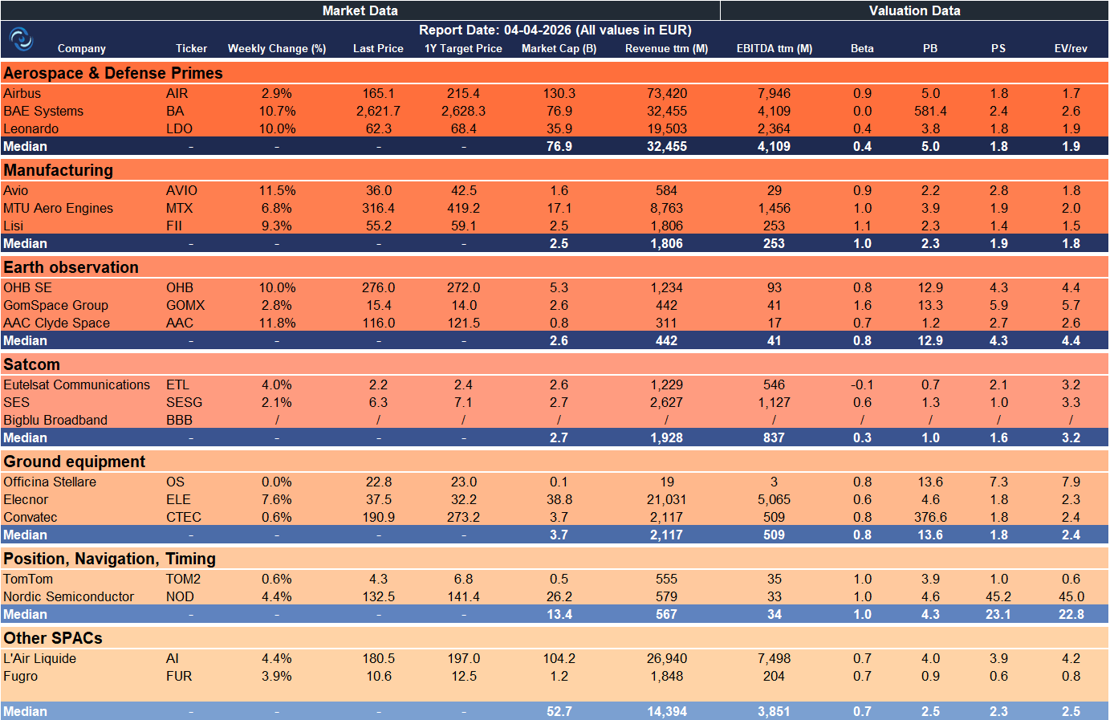
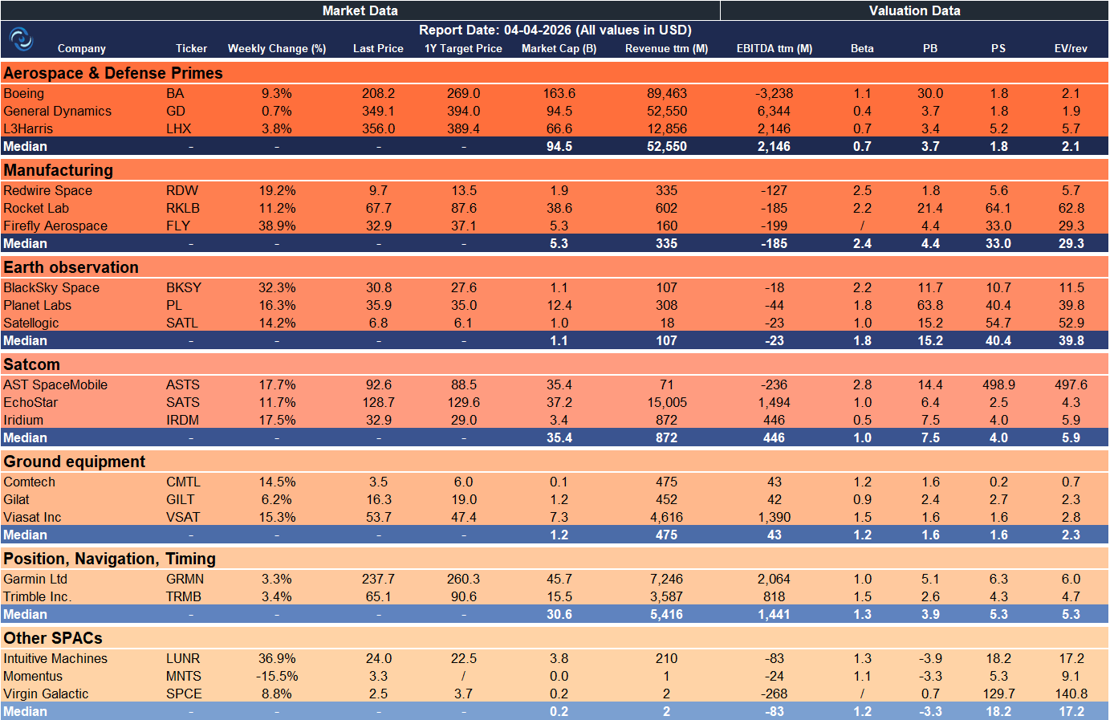
Weekly SpaceCap - These tables track weekly stock performance and key metrics for global and European SpaceTech companies, giving a quick snapshot of market trends. Data sourced from Yahoo Finance.
Europe – SpaceTech stocks snapshot

US – SpaceTech stocks snapshot

Read news in more detail
M&A & Funding
Aspect Aerospace gets funding to develop swarm-deployable VLEO satellites
What happened: Aspect Aerospace announced a $1.9 million SBIR award from the U.S. Space Force and a $500,000 pre-seed investment from SOSV, totaling $2.4 million. The company is developing its Single-Board Satellite concept, enabling a “constellation in a box” by deploying up to 100 SBS units from one host satellite for rapid environmental monitoring.
Why it matters: This funding supports a modular, swarm-style approach to space assets, allowing rapid deployment of satellite constellations in response to events. The SBS concept aims to rethink spacecraft design and deployment, enabling on-demand environmental monitoring and potentially faster, real-time data gathering than traditional single-satellite missions.
Investor angle: From an investor perspective, the milestones validate a scalable, modular platform with potential government and commercial demand. The ability to deploy up to 100 SBS units from a single host could broaden addressable markets for environmental monitoring and rapid-response sensing, while signaling early traction for SOSV-backed ventures.
Rocket Lab gets German approval for Mynaric deal
What happened: Rocket Lab has secured regulatory approval from Germany’s Federal Ministry for Economic Affairs and Energy to acquire Mynaric AG, a laser optical communications terminal maker. The deal, expected to close in April, will place Mynaric under Rocket Lab and establish the company’s first European footprint in Munich.
Why it matters: Laser communications are a key enabler for modern satellite constellations, offering higher data rates, greater security, and scalable spectrum use. The deal addresses a supply-chain bottleneck by bringing Mynaric’s terminals in-house, while giving Rocket Lab its first European footprint to expand support for European space programs and customers.
Investor angle: The acquisition enhances Rocket Lab’s end-to-end capabilities by adding scalable laser optical terminals, supporting growth in national security and commercial satellite customers. By acquiring Mynaric and expanding in Europe, Rocket Lab could improve supply at scale and potentially broaden contract opportunities, which may influence future valuations and funding prospects.
SpaceX files for initial public offering
What happened: Elon Musk’s SpaceX has confidentially filed for a U.S. IPO, aiming for a valuation of around $1.75 trillion. The Starbase, Texas-based company could raise $50 billion or more, eclipsing Saudi Aramco as the world’s largest IPO. The filing follows SpaceX’s merger with Musk’s AI startup xAI and comes as the company expands its Starlink satellite network and orbital data ambitions.
Why it matters: The IPO signals strong investor appetite for space, AI, and satellite communications. SpaceX dominates private launch and satellite operations, with Starlink providing recurring revenue from millions of subscribers and defense contracts, making it a test case for mega-IPOs in emerging tech sectors.
Investor angle: Investors see a chance to back Musk’s vision of space infrastructure, lunar ambitions, and AI-integrated satellites. Risks include valuing a sprawling, multi-business empire and dependence on Musk’s leadership, but a successful IPO could reshape both the space and public markets.
Antaris raises $28 million in Series A for AI space missions
What happened: Antaris raised $28 million in a first close of its Series A round, led by WestWave Capital with participation from Lockheed Martin Ventures, insiders, and new investors. The funding will accelerate development of the Antaris Intelligence platform, including Full Mission Virtualization and AI/ML for satellite mission design, simulation, and operations.
Why it matters: The investment underscores demand for software-defined space missions, where Antaris’ TrueTwin simulation and Full Mission Virtualization enable virtual testing and AI-driven autonomy across satellite design, manufacturing, and ops. It follows a MOA with SARsatX to build a 16-satellite constellation in Saudi Arabia and signals broader regional manufacturing partnerships.
Investor angle: Investors will see the round as backing Antaris’ expansion of global manufacturing partnerships and sovereign-region deployments, aligning with government and commercial demand for AI-native, software-defined space missions. The funding validates the platform-led approach and could strengthen the company’s competitive position as it scales and pursues additional rounds.
Starcloud becomes a unicorn after raising $170 million for orbital data centers
What happened: Starcloud, a startup building computing satellites, just closed a $170 million Series A, valuing it at $1.1 billion. The company launched its first satellite with an Nvidia H100 GPU in 2025 and plans a bigger Starcloud 2 later this year with multiple GPUs and even a bitcoin miner.
Why it matters: CEO Philip Johnston says their ultimate goal is cost-competitive orbital data centers using SpaceX’s Starship, but for now they’ll keep launching smaller satellites on Falcon 9. The tech is cutting-edge but unproven—power, cooling, and syncing GPUs in space are major hurdles.
Investor angle: Investors see a chance in space-based cloud computing, AI workloads, and satellite hardware—but the risks are high, and real scale may not happen until the next generation of rockets starts flying regularly.
Market
China plans 140 launches in 2026 as commercial space grows
What happened: China plans about 140 orbital launches in 2026, up from 92 in 2025, reflecting rapid growth of its commercial space sector. The projection was announced by CAS Space founder Yang Yiqiang. 2025 set a national launch record, and CAS Space achieved its first successful Kinetica-2 launch on March 30.
Why it matters: The plan signals a shift toward a larger, more commercialized Chinese space program and reflects policy support to grow space as a pillar industry. It includes investments in infrastructure (Jiuquan, Hainan pads, Haiyang) and a growing private sector, tied to ambitions for large satellite fleets like Guowang and Thousand Sails.
Investor angle: Investors may see opportunities in satellites, launch services, and related tech from the higher launch target and expanding commercial sector, supported by policy to deploy thousands of satellites annually. Risks include execution of infrastructure expansion and competition with established players; success could lift valuations of Chinese space firms.
Launch
Virgin Galactic plans to resume commercial suborbital flights later this year.
What happened: Virgin Galactic is reopening for commercial suborbital flights after a nearly two-year pause. It is selling a limited number of 90-minute trips at $750,000, with ground testing of the next-generation SpaceShip set for April and operations expected in late 2026, following 2024 cost-cutting pauses.
Why it matters: The return signals renewed investor interest in space tourism despite past setbacks, with Virgin Galactic pursuing a higher-priced product and a faster operational cadence through its next-generation SpaceShip. The move highlights ongoing efforts to reduce cost and expand repeat flights, even as demand remains uncertain.
Investor angle: For investors, the launch cadence and pricing imply a potential shift in Virgin Galactic’s revenue model if the next-generation ship can fly more often at higher prices. However, execution risk remains, given past delays and the gap between ticket sales and actual revenue realization.
NASA’s Artemis II mission departs Earth orbit for a flight around the Moon
What happened: NASA’s Artemis II mission has left Earth’s orbit and is en route to a flight around the Moon, marking a crewed test of deep-space operations within the Artemis program. The article notes related NASA updates, including a launch countdown and training materials for the mission.
Why it matters: This milestone advances NASA’s goal of returning humans to the Moon and developing deeper space capabilities, highlighting progress within the Artemis program and the role of public updates and mission-readiness resources in advancing space exploration.
Investor angle: Artemis II progress could affect aerospace suppliers and contractors involved in mission planning, countdown operations, and launch activities. Ongoing funding, milestones, and contract awards tied to the Artemis program may influence near-term revenue prospects and project risk for firms in the program’s supply chain.
Contracts
Italy and NASA agree to work together on the US-led lunar base.
What happened: In Washington, Adolfo Urso, Italy’s Minister for Enterprises and Made in Italy, signed a Statement of Intent with NASA Administrator Jared Isaacman to collaborate on the Artemis program. The agreement focuses on habitation modules, communications systems, and scientific activities for a sustained Moon presence, with Italian industry and research represented, and Teodoro Valente attending as president of the Italian Space Agency.
Why it matters: The move strengthens Italy’s role in the US-led lunar effort, leveraging a mature Italian aerospace supply chain and a long-standing Rome-Washington space partnership. With Artemis poised to mobilize tens of billions of dollars, the agreement signals broader international cooperation and positions Italy in a strategic, high-tech segment of the space industry.
Investor angle: The partnership could create long-term contract opportunities for Italian aerospace companies in Moon infrastructure, communications, and related systems within Artemis and NASA-ESA collaborations. It signals increased integration of Italian suppliers into a major, multi-year program, potentially benefiting the strategic position and growth of the sector.
Vantor wins contract to monitor space objects for intelligence agency
What happened: Vantor was awarded a $5.3 million NGA Luno B contract to deliver AI-powered change detection of Earth’s terrain. It will fuse data from Vantor’s imaging satellites and EO and SAR satellites to identify terrain changes and update Land Use Land Cover classifications, supporting NGA missions including disasters and humanitarian aid with detection.
Why it matters: This award underscores the growing use of AI-powered, multi-sensor geospatial analytics in national security and disaster response. By integrating Vantor’s satellites with third-party EO and SAR imagery, NGA can maintain up-to-date Land Use Land Cover data and support global monitoring, amid NGA’s agile procurement strategy to leverage commercial capabilities.
Investor angle: The contract signals recurring government revenue for Vantor and validates its AI-enabled, multi-sensor change-detection platform, potentially supporting a higher valuation as NGA expands its Luno program. It follows the June Luno A award for AI/ML object detections, indicating an ongoing government workflow and credibility of Vantor’s capabilities.
Disclaimer: This article is provided for informational purposes only and does not constitute investment advice. While we strive to ensure the accuracy and timeliness of the information presented, we cannot guarantee its completeness or correctness. Readers should conduct their own research and consult a qualified financial professional before making any investment decisions. Past performance is not indicative of future results.