
SpaceTech Weekly Recap – January 19–25, 2026
Major funding, new missions and setbacks: what mattered last week in space innovation.

Welcome to the newest version of SpaceTech Weekly, where we bring you a curated look each week at the biggest moves in SpaceTech – from funding and M&A to market trends, contracts and a quick stock snapshot. Subscribe to stay updated with the latest developments in SpaceTech. This recap is provided for informational purposes only and does not constitute investment advice.
“Money is moving into government-backed space infrastructure as countries focus more on defense and logistics. Australia’s Gilmour Space raised a big Series E round to develop their Eris rocket. Canada’s CRC got seed funding to work on launching rockets domestically. In Europe, Azimut invested in D-Orbit. There’s progress happening, but it’s not all smooth: Blue Origin is moving forward with crewed flights and their TeraWave project. Rocket Lab warned about some risks in testing their Neutron rocket. Meanwhile, Starfish Space won a contract from the Space Development Agency to help with satellite deorbiting.” - Commentary by Matej Pretković
We provide consulting, fundraising support, market research and advisory to help you grow and succeed. Contact us at mpretkovic@cyclopcorp.com
Here is a quick overview of news that happened this week:
M&A & Funding
Azimut Group completes €110 million deal with D-Orbit S.p.A.
Gilmour Space gets Australian investment to grow space capability
Samara Aerospace closes $10M seed round led by Balerion Space Ventures.
€73 million from ESA member states for HummingSat
Market
Canada Rocket Company reveals its operations
Launch
Rocket Lab updates on Neutron test
Blue Origin finishes 38th New Shepard flight to space
Blue Origin launches TeraWave, a 6 Tbps space-based network for global connectivity
Contracts
SDA partners with Starfish for satellite disposal service
Read our latest weeklies for more recent SpaceTech updates
Read our latest weeklies for more recent SpaceTech updates
Subscribe to keep up with the latest market movers in SpaceTech through carefully curated weekly updates
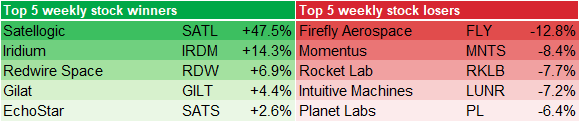
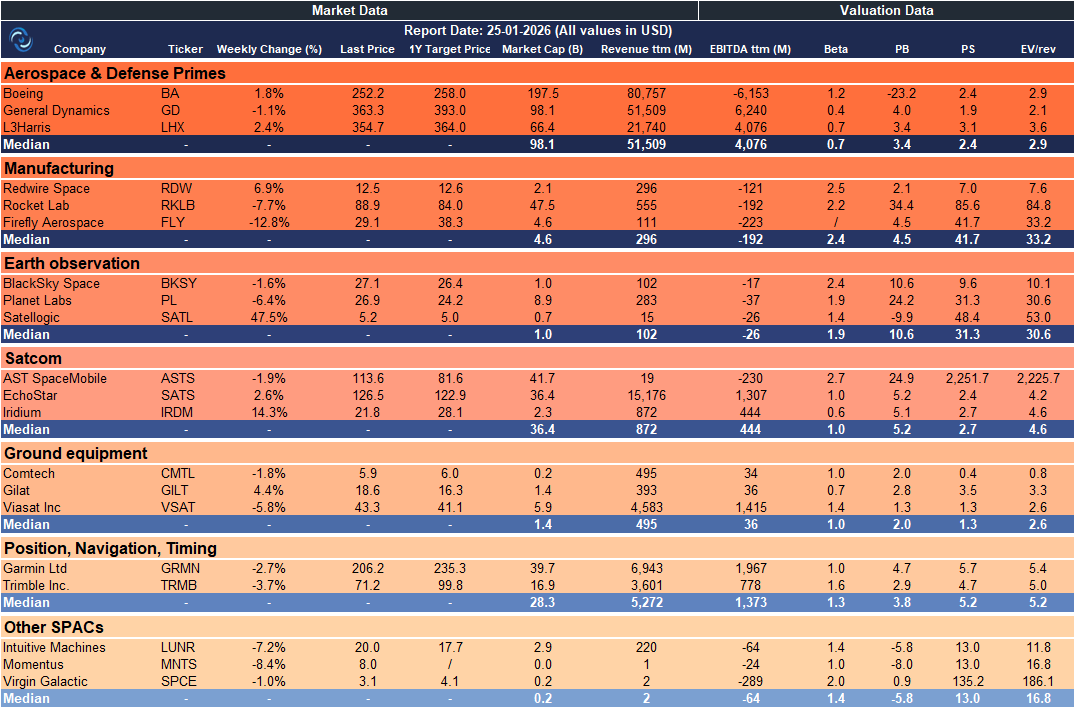
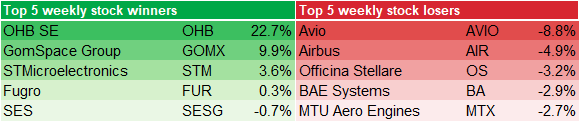
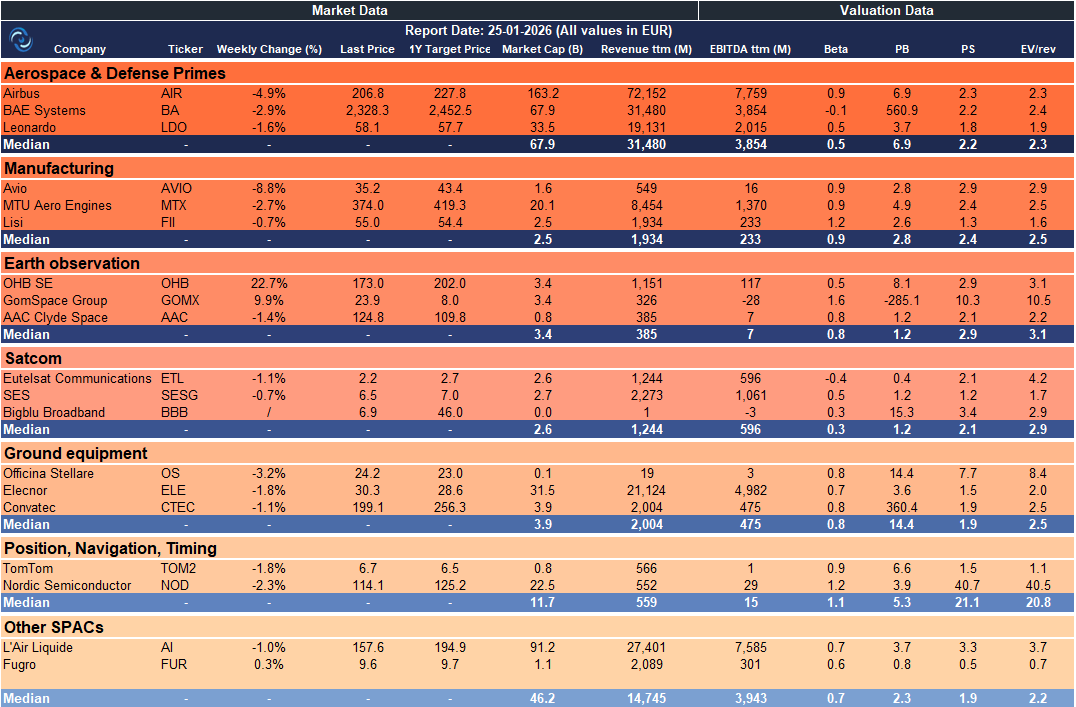
Weekly SpaceCap - These tables track weekly stock performance and key metrics for global and European SpaceTech companies, giving a quick snapshot of market trends. Data sourced from Yahoo Finance.
US – SpaceTech stocks snapshot
Europe – SpaceTech stocks snapshot
Read news in more detail
M&A & Funding
Azimut Group completes €110 million deal with D-Orbit S.p.A.
What happened: Azimut Group completed a €110 million club deal in D-Orbit S.p.A. through the vehicle Azimut Direct Investments SCA-SICAV-RAIF – D-Orbit. About 1,500 clients from Azimut’s Italian network of financial advisors and wealth managers participated as lead investor in a capital increase to support D-Orbit’s industrial and technological expansion, with D-Orbit described as a global leader in orbital logistics services and infrastructure for space operations.
Why it matters: The deal highlights Azimut’s role as lead investor and enabler of private clients backing strategic technology ventures in Italy, reinforcing confidence in D-Orbit’s decade-long industrial and technological path and in Europe’s future and technological competitiveness in space infrastructure.
Investor angle: This could be seen as a clear commitment from Azimut’s network to back high-tech industrial growth, potentially supporting D-Orbit’s expansion and value creation as Europe strengthens its space capabilities, and signaling a supportive funding environment for Italian tech-enabled industrial players.
Gilmour Space gets Australian investment to grow space capability
What happened: Gilmour Space Technologies secured 217 million dollars in private equity in a Series E round led by the National Reconstruction Fund Corporation and Hostplus, with participation from Future Fund and others. Proceeds will support Eris launch vehicle development, rocket and satellite manufacturing, and the growth of Australia’s sovereign space capability.
Why it matters: The investment underscores the strategic importance of domestic space capability, as access to space enables critical services such as communications, navigation, and climate monitoring, plus national security and disaster response. It positions Australia to secure essential space services, grow advanced manufacturing, and create high-skilled jobs in the region.
Investor angle: The round could be seen as validation of Gilmour Space’s team and Australia’s sovereign space ambitions, funding scale-up of Eris, manufacturing, and launch infrastructure to meet rising demand. The money is framed as delivering long-term value and potential risk-adjusted returns for members, while expanding domestic high-skill jobs and capability.
Samara Aerospace closes $10M seed round led by Balerion Space Ventures.
What happened: Samara Aerospace announced it has closed a $10 million seed round led by Balerion Space Ventures. The round was oversubscribed and pre-empted, driven by rapid flight execution and growing government and commercial demand. The funding will accelerate production scaling, team expansion, and preparation for the first mission, Hummingbird-1, after moving from concept to flight-ready hardware.
Why it matters: The oversubscribed seed round signals strong investor interest in space tech with tangible flight-ready progress and multi-sector demand from government and commercial customers. The funding supports faster scaling and moves Samara closer to launching its first mission, reflecting broader momentum in the space sector toward rapid development.
Investor angle: The round’s oversubscription and lead investor indicate solid early validation and momentum for Samara, potentially aiding faster milestones and more favorable future fundraising. Risks remain, including execution and scaling challenges for a small team as it moves toward flight-ready hardware.
€73 million from ESA member states for HummingSat
What happened: SWISSto12 secured €73 million ($84.8 million) in funding from ESA member states through the HummingSat ARTES partnership project to accelerate development and industrialization of its next-generation compact satellite, HummingSat. Combined with private European investments raised in late 2025, total funding exceeds €100 million. The HummingSat platform, designed for cost-efficient, sovereign satellite communications, is scheduled for first launch with SES in 2027, followed by Viasat.
Why it matters: This significant institutional and private funding highlights strong confidence in SWISSto12’s innovative approach to satellite communications, moving the industry toward smaller, agile, software-defined, multi-orbit capable satellites. HummingSat’s flexibility and cost-efficiency address growing global demand for broadband connectivity, secure sovereign communications, and new services across government and commercial sectors.
Investor angle: The large funding commitment from ESA member states and private investors validates SWISSto12’s technology and commercial potential, positioning it well for scaling manufacturing and expanding product innovations. Investors benefit from backing a company at the forefront of satellite sovereignty and next-gen SatCom solutions, though risks remain related to technology development, market adoption, and execution ahead of the 2027 launch.
Market
Canada Rocket Company reveals its operations
What happened: Canada Rocket Company (CRC), a Toronto-based launch startup, emerged from stealth and announced a C$6.2 million seed round (~US$4.5 million) to pursue sovereign light- and medium-lift launch capabilities. It was led by the Business Development Bank of Canada and Garage Capital, with Ripple Ventures, Panache Ventures, Northside Ventures, and Cold Capital participating.
Why it matters: The move signals Canada’s growing push to establish domestic launch capability, supported by programs like Launch the North and a C$105 million public fund to reach LEO by 2028. CRC plans a scalable methalox architecture using high-TRL subsystems from Canada and Europe to meet the timeline.
Investor angle: CRC has secured an all-Canadian seed syndicate and attracted SpaceX alumni talent, which could reduce technical risk in propulsion and avionics. Key risks include the tight 2028 timeline, reliance on government funding, and competition from other Canadian players such as NordSpace and Reaction Dynamics.
Launch
Rocket Lab updates on Neutron test
What happened: Rocket Lab said a Stage 1 Neutron tank ruptured during a qualification test. Such testing can produce failures when pushing structures to their limits. There was no damage to the test setup or facilities. A new Stage 1 tank is in production, and development continues while data are reviewed for schedule impact.
Why it matters: Rocket Lab notes it pushes Neutron to the limits to qualify its systems for launch, so the rupture highlights testing to validate structural integrity and safety margins for a medium-lift vehicle. An update will come at February earnings call. Neutron aims to enable medium launches for constellations and national-security missions.
Investor angle: The result introduces near-term schedule risk as Neutron’s qualification tests continue, but there is no material damage to reduce immediate costs. Ongoing Stage 1 tank production and a forthcoming earnings update keep visibility on Neutron’s path to medium-lift missions for constellations and national security.
Blue Origin finishes 38th New Shepard flight to space
What happened: Blue Origin completed the 38th New Shepard flight (NS-38), the first of 2026. The mission carried six crew members: Tim Drexler, Dr. Linda Edwards, Alain Fernandez, Alberto Gutiérrez, Jim Hendren, and Dr. Laura Stiles, who replaced an ill crewmate. New Shepard has now flown 98 humans (92 individuals) to space.
Why it matters: This flight highlights Blue Origin’s ongoing focus on reliable, repeatable access to space through a proven, reusable system. As New Shepard enables testing of core technologies and operational procedures, it underpins Blue Origin’s broader road to space and the company’s goal of expanding human activity in space.
Investor angle: The flight demonstrates Blue Origin’s ability to sustain a flight cadence and validate crewed spaceflight operations, which can support customer confidence in the New Shepard program and benefit its commercial spaceflight offerings, potentially influencing long-term valuation and strategic positioning in the space industry.
Blue Origin launches TeraWave, a 6 Tbps space-based network for global connectivity
What happened: Blue Origin announced TeraWave, a space-based network delivering symmetrical speeds up to 6 Tbps anywhere on Earth for enterprise, data center, and government users. The system uses 5,408 optically interconnected satellites in LEO and MEO (5,280 LEO, 128 MEO). Deployment begins in Q4 2027, with rapid, infrastructure-friendly terminals.
Why it matters: TeraWave signals a shift toward space-based backhaul that can supplement fiber and reach underserved areas. Its multi-orbit design and high-throughput links aim to deliver both high speeds and redundancy, benefiting enterprise, data center, and government customers seeking reliable, scalable connectivity beyond traditional fiber routes.
Investor angle: For investors, TeraWave outlines a potential new revenue stream for Blue Origin through enterprise and government connectivity offerings and a diversified, high-capacity backbone that complements fiber. Key considerations include the costly capital program and the timelines to reach scale, with first deployments slated for late 2027.
Contracts
SDA partners with Starfish for satellite disposal service
What happened: The U.S. Space Development Agency (SDA) awarded Starfish Space a $52.5 million contract to provide satellite disposal services for its Proliferated Warfighter Space Architecture (PWSA) satellites at end-of-life. Starfish will deploy its Otter vehicle, designed to rendezvous with and safely deorbit satellites without requiring prior modifications. The first launch of Otter is planned for 2027, with options to expand the service based on on-orbit performance.
Why it matters: This contract is a pioneering effort to address growing concerns about space debris by enabling the active disposal of satellites across low Earth orbit (LEO) constellations. Otter’s ability to dock with “unprepared” satellites from multiple providers allows flexible, scalable disposal services that support SDA’s constellation management and sustainability goals. The commercial viability requirement also positions Starfish to offer similar services to other satellite operators.
Investor angle: The $52.5 million contract from a major U.S. defense agency validates Starfish’s technology and market potential in the emerging satellite servicing and debris mitigation sector. Starfish’s prior demonstration contracts with NASA and Intelsat (SES), plus its multi-orbit propulsion capabilities, strengthen its competitive position. Key risks include execution challenges in developing and deploying complex rendezvous and disposal missions and securing follow-on commercial contracts beyond government customers.
How Cyclop SpaceTech can help you
Whether you’re a space operator, investor, startup, policymaker, or enthusiast, we help you learn, grow and succeed in the fast-changing world of SpaceTech.
Consulting: We give expert advice to help with your space projects.
Courses: Learn space economy step-by-step, from beginner to advanced.
1-on-1 consulting: Get individual professional assistance.
Research: We help you find and understand important space info.
Deep dives: Explore custom space topics in detail, made easy.
Analysis: We review and explain SpaceTech trends and data.
Business development & marketing: We help you grow your venture with tailored strategies and market visibility.
Contact us at mpretkovic@cyclopcorp.com
We’d love your feedback on SpaceTech Weekly - help us improve and get 15% off our services!
Disclaimer: This article is provided for informational purposes only and does not constitute investment advice. While we strive to ensure the accuracy and timeliness of the information presented, we cannot guarantee its completeness or correctness. Readers should conduct their own research and consult a qualified financial professional before making any investment decisions. Past performance is not indicative of future results.