
E2MC Founding Partner Raphael Roettgen on Investing in Early-Stage Space Ventures and In-Space Manufacturing
Raphael Roettgen, founding partner of E2MC (Earth-to-Mars Capital), explains how in-space manufacturing startups use microgravity, benefit from accelerators, and why they’re interesting investments.

As space becomes more accessible, understanding how early-stage ventures can leverage microgravity and other unique conditions is critical for identifying the next wave of transformative technologies—technologies that target significant markets right here on Earth.
To explore this perspective, we spoke with Raphael Roettgen, whose background gives him a financial lens for identifying startups that can turn microgravity-driven experiments into commercially viable opportunities.
Raphael, founder of E2MC, has moved from investment banking and hedge funds into space venture capital, driven by a desire to back technologies that can make a real-world impact. In this conversation, he explains how his background shapes his evaluation of early-stage space startups and what he looks for in teams, markets, and technology, and discusses how microgravity creates opportunities that cannot be replicated on Earth. Raphael also highlights the role of accelerators in helping founders turn experiments into scalable ventures.
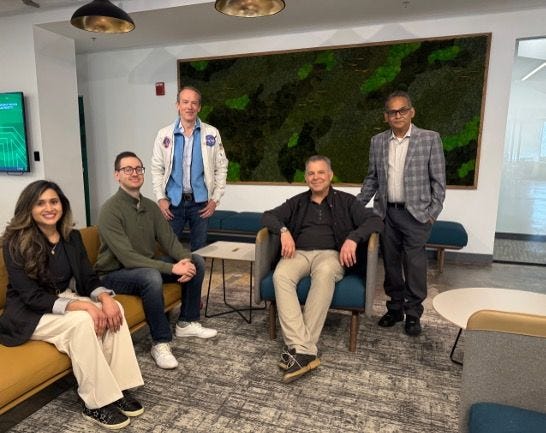
Here is our chat:
Raphael, you transitioned from investment banking to hedge funds and now to space venture capital. As I understand, that was driven by a desire to make an impact. How has this experience shaped your approach to evaluating frontier space technology, especially in in-space manufacturing, and supporting founders in this niche?
Yeah, my background, as you mentioned, is very much a finance—or sometimes people say Wall Street—background. I was an investment banker in Mergers & Acquisitions (M&A) and then an investor in so-called long-short equity investing in the public markets.
From my time as a long-short investor, one important point is that I was value-driven. Even in venture investing, where early-stage companies often have no product, revenue, or profit yet, this discipline reminds you that ultimately a company has to have cash flows for intrinsic value to exist. They may reinvest all cash flows for many years in R&D and/or business development, which is fine, but the theoretical foundation for value has to be there.
Even in early-stage venture investing, where companies may have no product or revenue, a value-driven mindset reminds you that intrinsic value ultimately depends on future cash flows.
It’s also more of a mental model. For early-stage startups, doing a full so-called discounted cash flow analysis (DCF) is a waste of time. But you can make a simple back-of-the-envelope calculation, even in your head, to estimate what revenue and cash flow could look like in the medium-term and try to estimate future, and present value, from there.
From investment banking, I learned about M&A and how larger corporations think about acquisitions. Many innovative space companies do things that large aerospace corporations cannot do in-house, often simply for cultural reasons. It’s viable for startups to innovate, then later be acquired. This gives investors one potential path to exit, similar to how banks acquired fintech startups after startups in that sector innovated.
E2MC invests globally, starting from the pre-seed and seed stages, with a diverse portfolio including Atmos, Space Forge, and Interstellar Lab. When it comes to startups leveraging space stations for in-space manufacturing, what core traits or patterns do you look for?
Being very early-stage investors, some things are the same as for other early-stage investing. First and foremost, it’s the team. We need to believe in the team.
Important aspects are motivation—they need to have the right motivation because it’s incredibly tough to be an entrepreneur. Also, qualifications, especially technical knowledge relevant to the proposed work, are crucial.
Next, we want to see large potential markets. Startups may pivot, but eventually, there has to be a market large enough to reach so-called “venture scale.” And finally, technology: it has to be credible, differentiated, and to some extent proprietary, through patents and/or trade secrets.
For early-stage investing, the team comes first—passion, expertise, and motivation matter most—followed by a large market opportunity and credible, differentiated technology.
You also build accelerators like Orbital Edge in the U.S. and KickSky in India. How do your accelerators help founders navigate the unique challenges of space ventures?
Ours are highly specialized accelerators. Many general accelerators help startups write pitches or give general business coaching. We do that, too, but we also bring subject-matter expertise and a network specific to space. We connect founders to mentors, potential customers, suppliers, board members, and investors.
General accelerators teach the basics—specialized ones open doors, bring experts, and fuel growth with money and connections.
KickSky, hybrid but based in Bangalore, is focused on India. Among other things, we help these startups access the U.S., which is something most space companies eventually want to do.
Orbital Edge, going through its first startup cohort right now, is a U.S.-based accelerator for startups that can leverage a space station. It’s a partnership between E2MC and ISS National Lab, Ciri and Stellar Ventures.
We give some money to startups and, in return, get equity. The model differs slightly between KickSky and Orbital Edge, but that’s the general approach.
In your portfolio of in-space manufacturing ventures, how do you identify startups that can translate experiments conducted in orbit into scalable products or services?
At this stage, no one in the industry has fully demonstrated the ability to go from in-space experiments to a scalable commercial business. It’s simply too early to claim that a proven path exists. That said, when we evaluate in-space manufacturing ventures, we focus on identifying applications where there’s clear evidence that space conditions—like microgravity—provide a measurable advantage over Earth-based processes.
Microgravity cannot be sustainably replicated on Earth—while short timeframes can be achieved, there’s no way to maintain true microgravity over time.
We look for cases where experiments, often conducted on the ISS or other platforms, have already proven that a concept works and produces better outcomes in space than on Earth. For example, protein crystallization in microgravity can yield higher-quality protein structures, which has commercial implications for certain drugs and for drug development.
Varda in the US and the much earlier-stage BioOrbit in Europe are pursuing protein crystallization in microgravity, aiming to unlock the commercial value of higher-quality protein-based drugs.
The key criteria we focus on when investing are:
Demonstrated advantage in space – The concept has already been shown to work better in microgravity or other space conditions than on Earth.
Commercial potential – There’s a credible case for significant market value and a sizable addressable market.
Strong execution team – The founders bring deep expertise in the relevant science or application area, and have the right mix of skills to execute.
Access to enabling technology – The team either already has, or can reliably access, the technology and infrastructure needed to bring the idea to life.
We distinguish between in-space manufacturing applications—like Prometheus Life Technologies producing organoids, LambdaVision producing artificial retinas or a company in Orbital Edge called Olfera that's aiming to produce a certain type of organ-on-chip chip model with olfactory neurons in space;
and infrastructure platforms—like Space Forge or VAST, which provide the physical platforms to manufacture in space. While we’ve invested in both types of businesses, our current focus is on applications that can leverage platforms without necessarily owning them, because the platform space is becoming more mature and later-stage.
Raphael and his team are looking for subject-matter experts in life sciences and material sciences going after use cases already proven in space, which can now be commercialized thanks to cheaper and more frequent space access and return.
Can founders from non-space sectors successfully build space ventures, and how do you assess if their idea genuinely benefits from being in space?
For applications companies, the founders need to be subject-matter experts in their own field, but they do absolutely not need to be part of the space community yet. They should understand enough about space to clearly justify why their project needs to be done there. For example, LambdaVision’s founder Nicole Wagner, with a life sciences background, showed that microgravity in space can be used to build artificial retinas by layering a protein 200 times – something impossible on Earth, where gravity would cause the structure to collapse after a few layers.
All this mirrors what happened with the internet: the first internet companies were started by computer scientists who understood the technology, but the majority of the most impactful applications came from experts in other industries who used it as a tool to solve real problems. Similarly, in space, we’re looking for people from other fields—biology, materials science, and beyond—who recognize the unique advantages of space, principally microgravity, and can turn that insight into commercially viable businesses. What usually doesn’t work is space engineers trying to operate outside their domain; the most promising applications ventures come from true domain experts leveraging space as a tool.
Such an insightful read! This one really resonates with me as I am part of KickSky Accelerator (focused on SpaceTech) which is backed by E2MC and Riceberg Ventures.
I would love to share this interview further on my LinkedIn if that’s okay with you.
Great takeaway! "Even in venture investing, where early-stage companies often have no product, revenue, or profit yet, this discipline reminds you that ultimately a company has to have cash flows for intrinsic value to exist. They may reinvest all cash flows for many years in R&D and/or business development, which is fine, but the theoretical foundation for value has to be there."